

LNG Bunkering Market
Market Overview
The LNG Bunkering Market is gaining importance as the global shipping industry seeks alternative marine fuels that can reduce air pollution and support environmental compliance. LNG bunkering refers to the process of supplying liquefied natural gas (LNG) to ships for use as fuel. Compared with conventional marine fuels, LNG produces lower sulfur oxide and particulate matter emissions and can reduce nitrogen oxide emissions. Its greenhouse gas benefits depend on engine technology, methane leakage, and the full fuel lifecycle.
The market is supported by growing environmental awareness, stricter marine emission regulations, and the transition toward cleaner shipping operations. Shipowners, port operators, energy companies, and fuel suppliers are investing in LNG supply infrastructure to meet the changing requirements of maritime transportation.
However, the market faces challenges, including high infrastructure investment, limited bunkering facilities in some ports, LNG price fluctuations, and competition from other alternative marine fuels. These factors influence investment decisions and the pace of adoption across shipping markets.
Download Free PDF Brochure@https://www.maximizemarketresearch.com/request-sample/20915/
Market Size and Growth
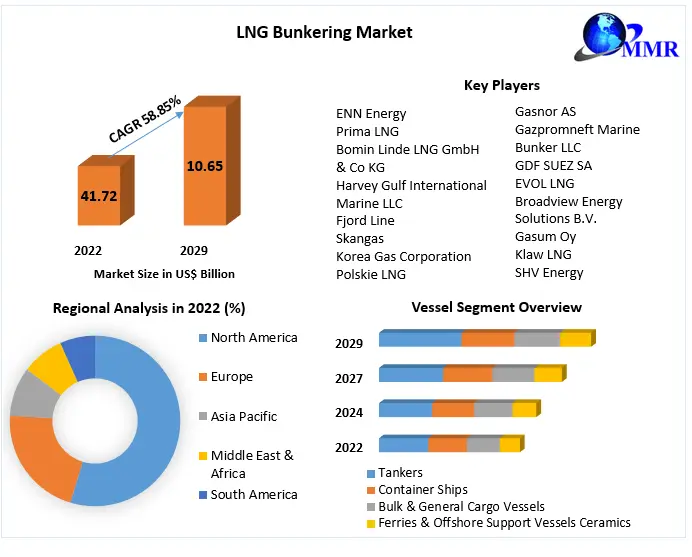
According to Maximize Market Research, the global LNG Bunkering Market was valued at US$41.72 billion in 2022 and was projected to reach US$10.65 billion by 2029, with a reported CAGR of 58.85% during 2023–2029. These figures are reproduced from the referenced report, but the starting value, forecast value, and stated growth rate appear inconsistent and should be verified against the original report before publication.
Market expansion is associated with the growing use of LNG-fueled vessels and the development of specialized bunkering infrastructure. Shipping companies are evaluating LNG as one option for reducing certain air pollutants while meeting evolving environmental requirements.
Investment in LNG terminals, storage facilities, bunker vessels, and fuel-transfer systems is also supporting industry development. Nevertheless, the pace of market growth depends on fuel price competitiveness, infrastructure availability, regulatory developments, and the adoption of alternative marine energy sources.
Key Market Segmentation
The LNG Bunkering Market is segmented by vessel type, product type, end use, and geography. These categories help identify demand patterns and infrastructure requirements across the maritime industry.
By Vessel Type: The market includes tankers, container ships, bulk and general cargo vessels, ferries, and offshore support vessels. Ferries and offshore support vessels represent important application areas because of their regular operating routes and fuel requirements. Container ships and tankers also offer opportunities as shipping companies explore LNG-powered fleets.
By Product Type: Major segments include ship-to-ship, port-to-ship, truck-to-ship, and portable tank bunkering. Ship-to-ship bunkering enables fuel transfer directly between vessels and can support large-volume operations. Truck-to-ship bunkering offers flexibility, particularly where fixed infrastructure is limited. Port-to-ship systems provide another method of supplying LNG through port-based facilities.
By End Use: Key segments include ferries, cruise ships, bulk and general cargo fleets, offshore support vessels, and tanker fleets. Demand varies according to vessel operating patterns, fuel consumption, and access to LNG supply infrastructure.
Growth Drivers
Environmental regulations are a major driver of the LNG Bunkering Market. International maritime emission standards encourage shipping operators to reduce sulfur oxide and other air pollutants. LNG can help vessels meet certain emissions requirements, making it an attractive option for some operators.
The expansion of international maritime trade also contributes to market development. As shipping companies transport goods across major trade routes, demand for reliable marine fuel supply increases. The introduction of LNG-powered vessels creates additional requirements for bunkering services and specialized port infrastructure.
Furthermore, investments in LNG terminals, storage systems, and bunker vessels are improving fuel availability. Government initiatives supporting cleaner energy and industrial investment in natural gas infrastructure can provide additional opportunities. However, high capital costs and uncertain long-term fuel demand remain significant barriers.
Emerging Trends
The market is witnessing growing interest in advanced bunkering methods and more efficient fuel-transfer infrastructure. Ship-to-ship bunkering is gaining attention because it can accommodate different vessel sizes and support flexible fuel delivery operations.
Digital monitoring, automated transfer systems, and improved safety procedures are also becoming increasingly important. LNG must be handled at extremely low temperatures, making specialized equipment, trained personnel, and rigorous safety management essential.
Another emerging trend is the evaluation of LNG alongside alternative marine fuels, including biofuels, methanol, ammonia, and hydrogen-based options. Shipping companies are comparing fuel availability, costs, emissions performance, and vessel compatibility before committing to long-term investments.
Regional Analysis
Europe is a significant region in the LNG Bunkering Market, supported by established LNG infrastructure and the adoption of alternative marine fuels. Norway is particularly important because of its experience with LNG-powered vessels and marine fuel supply operations. Investment in port infrastructure and environmental initiatives continues to support regional development.
North America offers growth opportunities through natural gas production, established LNG supply capabilities, and marine transportation activities. The United States is an important market for LNG bunkering infrastructure, particularly around ports serving commercial shipping and offshore operations.
Asia Pacific is supported by extensive maritime trade, major shipping hubs, and the presence of countries such as China, Japan, and South Korea. These countries have significant shipping and energy industries that can support LNG bunkering adoption.
The Middle East and Africa and South America also present opportunities as ports modernize their infrastructure and explore alternative marine fuels. Regional growth will depend on investment, fuel availability, and shipping demand.
Competitive Landscape
The LNG Bunkering Market includes energy companies, LNG suppliers, marine fuel distributors, and specialized shipping operators. Competition is influenced by fuel availability, infrastructure coverage, operational safety, pricing, and service reliability.
Key players identified by Maximize Market Research include ENN Energy, Prima LNG, Bomin Linde LNG GmbH & Co. KG, Harvey Gulf International Marine, Fjord Line, Gasum, Korea Gas Corporation, Shell, Crowley Maritime Corporation, Gasnor, PETRONAS, ExxonMobil, TotalEnergies, and GDF SUEZ.
These companies participate in different parts of the LNG supply chain, including fuel distribution, terminal operations, shipping, and bunkering services. Market participants can strengthen their competitive positions through infrastructure investment, strategic partnerships, improved operational efficiency, and expansion into major maritime hubs.
Download Free PDF Brochure@https://www.maximizemarketresearch.com/request-sample/20915/
Recent Developments
Developments in LNG bunkering are centered on expanding supply infrastructure, improving fuel-transfer capabilities, and supporting the adoption of LNG-powered vessels. Energy companies and port operators are exploring new partnerships to strengthen fuel availability and improve access to bunkering services.
Investment in dedicated LNG bunker vessels, storage facilities, and truck-to-ship operations can help expand supply options. Improvements in transfer technology and safety procedures are also important for managing LNG's low-temperature handling requirements.
The referenced Maximize Market Research report was updated in June 2023 and does not establish a comprehensive list of recent, dated company announcements. These developments therefore describe broader industry directions rather than specific newly announced projects.
Future Outlook
The LNG Bunkering Market is expected to evolve as shipping operators balance emission reduction goals, operating costs, fuel availability, and regulatory requirements. Continued investment in LNG-powered vessels and bunkering infrastructure could support demand across major ports and maritime trade routes.
Future opportunities may emerge from improved ship-to-ship transfer systems, expanded LNG distribution networks, and stronger collaboration between shipping companies and energy suppliers. At the same time, competition from alternative fuels and concerns about methane emissions could influence long-term investment decisions.
Companies that prioritize operational safety, reliable supply, cost efficiency, and adaptable infrastructure may be better positioned to respond to changing maritime fuel requirements.
For full access to the comprehensive strategic report, visit:https://www.maximizemarketresearch.com/market-report/lng-bunkering-market/20915/
Conclusion
The LNG Bunkering Market plays an important role in the transition toward cleaner marine transportation. Growing environmental requirements, international shipping activity, and investment in LNG infrastructure are supporting the development of bunkering services. Although high capital expenditure, infrastructure gaps, and competition from alternative fuels remain challenges, technological improvements and strategic partnerships may create further opportunities. The market's long-term prospects will depend on the economics of LNG, environmental performance, and the maritime industry's evolving energy choices.
About Maximize Market Research
Maximize Market Research is a multifaceted market research and consulting company with professionals from several industries. Some of the industries we cover include medical devices, pharmaceutical manufacturers, science and engineering, electronic components, industrial equipment, technology and communication, cars and automobiles, chemical products and substances, general merchandise, beverages, personal care, and automated systems. To mention a few, we provide market-verified industry estimations, technical trend analysis, crucial market research, strategic advice, competition analysis, production and demand analysis, and client impact studies.
Contact Maximize Market Research
3rd Floor, Navale IT Park, Phase 2
Pune Bangalore Highway, Narhe,
Pune, Maharashtra 411041, India
sales@maximizemarketresearch.com
+91 96071 95908, +91 9607365656


