
Business Travel Market: Growth, Trends, Segmentation, and Forecast
Market Overview
The global Business Travel Market plays a significant role in connecting companies, professionals, and organizations across domestic and international markets. Business travel includes employee trips for client meetings, conferences, exhibitions, training programs, project visits, product launches, and market expansion. It covers transportation, hotel accommodation, ground transfers, and corporate travel management services.
As businesses expand internationally, face-to-face meetings remain important for building relationships, negotiating contracts, developing partnerships, and exploring new opportunities. Digital booking platforms and corporate travel management solutions are also transforming how companies organize trips, monitor expenses, and manage travel policies.
Download Free PDF Brochure@https://www.maximizemarketresearch.com/request-sample/190551/
Market Size and Growth
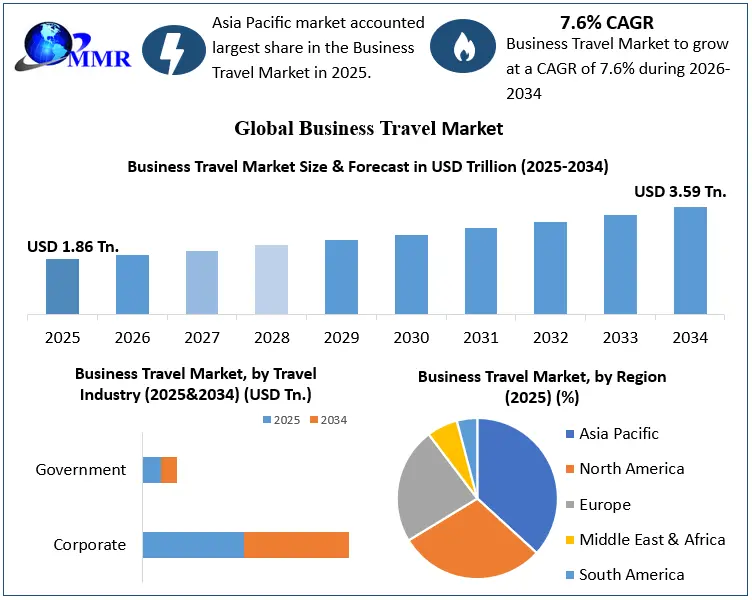
According to Maximize Market Research, the global Business Travel Market was valued at USD 1.86 trillion in 2025 and is projected to reach USD 3.59 trillion by 2034, registering a compound annual growth rate (CAGR) of 7.6% from 2026 to 2034.
Market growth is supported by international business expansion, corporate investment, trade events, and increasing demand for professional meetings. Companies are investing in travel services that help employees connect with customers and business partners. However, rising flight fares, accommodation costs, and strict corporate budgets can limit travel spending, particularly among small and medium-sized enterprises.
Key Market Segmentation
The Business Travel Market is segmented by type, traveller, purpose, booking type, travel industry, and service type.
By Type: Managed business travel and unmanaged business travel are the primary categories. Managed travel involves organized booking processes and corporate policies, while unmanaged travel allows employees or businesses to arrange trips independently.
By Traveller: The market includes solo and group travel. Solo travel commonly supports individual meetings and site visits, whereas group travel serves conferences, exhibitions, and corporate events.
By Purpose: Major purposes include marketing, internal meetings, trade shows, product launches, and other business activities.
By Booking Type: Online travel agencies, direct bookings, and corporate travel management companies provide booking options for businesses with different requirements.
By Travel Industry: Government and corporate organizations generate demand for business travel services.
By Service Type: Transportation, food and lodging, recreational activities, and other services support the overall business travel experience.
Growth Drivers
The expansion of international trade and corporate activities is a major driver of the Business Travel Market. Companies travel to meet clients, attend industry exhibitions, inspect project sites, negotiate agreements, and establish business partnerships. Growing investment in technology, manufacturing, healthcare, banking, and consulting also creates demand for professional travel services.
The expansion of small and medium-sized enterprises is another growth factor, as smaller businesses increasingly seek affordable travel booking and management solutions. Integrated platforms that combine flights, accommodation, expense tracking, and approval processes can simplify corporate travel management.
However, increasing travel costs, itinerary disruptions, and the availability of virtual meetings may encourage organizations to limit non-essential trips.
Technology is reshaping business travel through artificial intelligence (AI), online booking platforms, and integrated travel and expense management systems. AI-powered tools can help companies compare travel options, recommend suitable itineraries, and manage bookings according to corporate policies.
Another emerging trend is bleisure travel, which combines business activities with personal leisure. Flexible itineraries and extended hotel stays are creating opportunities for travel providers.
Sustainability is also gaining attention, with companies seeking better visibility into travel-related carbon emissions and exploring more environmentally conscious transportation and accommodation options. Businesses are increasingly using digital tools to monitor expenditure, improve travel planning, and evaluate the value of corporate trips.
Regional Analysis
Asia Pacific leads the Business Travel Market, supported by expanding business activities, industrialization, and international trade. China, India, Japan, and South Korea contribute to regional demand through corporate expansion, conferences, and growing business networks.
North America remains a major market because of its multinational corporations, technology industry, and extensive corporate travel requirements. The United States is an important contributor, particularly through business meetings, conferences, and international operations.
Europe benefits from established business centres, multinational companies, trade fairs, and cross-border commercial activity. Cities such as London, Paris, and Frankfurt support demand for corporate accommodation and transportation.
South America presents opportunities through international trade, corporate events, and developing business travel infrastructure. Meanwhile, the Middle East and Africa benefit from growing conference activity, international investment, and demand for business accommodation and air transportation.
Competitive Landscape
The Business Travel Market includes corporate travel management companies, booking platforms, travel service providers, and technology businesses. Competition centres on booking convenience, cost management, customer service, integrated expense tools, and the ability to support international travel requirements.
Key Players
1. American Express Global Business Travel (Amex GBT)
2. BCD Travel
3. Flight Centre Travel Group Limited
4. Corporate Travel Management Limited (CTM)
5. Navan, Inc.
6. SAP Concur
7. Perk (formerly TravelPerk)
8. Direct Travel, Inc.
9. ATPI Ltd.
10. JTB Corporation
11. Internova Travel Group
12. Omega World Travel, Inc.
13. World Travel, Inc.
14. ADTRAV Travel Management
15. Fox World Travel
16. Gray Dawes Travel
17. Gant Travel
18. Christopherson Business Travel
19. TravelStore
20. Uniglobe Travel International
21. Key Travel
22. Kintetsu International
23. Lufthansa City Center
24. ATG Travel Worldwide
25. TAG
26. Engine (formerly Hotel Engine)
27. ITILITE
Companies are strengthening their offerings through digital platforms, automated expense management, personalized booking services, and solutions designed for organizations of different sizes.
Download Free PDF Brochure@https://www.maximizemarketresearch.com/request-sample/190551/
Recent Developments
Recent developments demonstrate the industry's focus on AI, integrated services, and sustainable business travel.
-
September 2026: Navan announced the acquisition of BoomPop, an AI-powered enterprise events platform, to strengthen its corporate events and meetings services.
-
September 2026: BCD Travel integrated sustainability features into its TripSource platform to support environmentally conscious travel planning.
-
July 2026: Navan introduced Model Context Protocol connectivity to link corporate travel and expense data with AI tools.
-
April 2026: The Global Business Travel Association highlighted affordability and employee safety as important concerns for corporate travel managers.
These developments illustrate how travel providers are combining technology, expense visibility, and sustainability features to respond to changing corporate requirements.
Future Outlook
The Business Travel Market is expected to expand through 2034 as companies continue investing in international relationships, corporate events, and business development. AI-assisted booking, integrated travel management, and flexible travel packages are likely to create additional opportunities.
At the same time, businesses will continue balancing travel budgets with the benefits of in-person engagement. Providers that offer transparent pricing, efficient booking, reliable support, and improved expense management will be well positioned to compete.
Conclusion
The global Business Travel Market is projected to grow from USD 1.86 trillion in 2025 to USD 3.59 trillion by 2034, at a CAGR of 7.6%. International business expansion, corporate events, digital booking tools, and AI-enabled travel management are expected to support market development. Companies that combine cost efficiency, flexibility, and sustainable travel solutions will play an important role in shaping the industry's future.
About Maximize Market Research
Maximize Market Research is a multifaceted market research and consulting company with professionals from several industries. Some of the industries we cover include medical devices, pharmaceutical manufacturers, science and engineering, electronic components, industrial equipment, technology and communication, cars and automobiles, chemical products and substances, general merchandise, beverages, personal care, and automated systems. To mention a few, we provide market-verified industry estimations, technical trend analysis, crucial market research, strategic advice, competition analysis, production and demand analysis, and client impact studies.
Contact Maximize Market Research
3rd Floor, Navale IT Park, Phase 2
Pune Bangalore Highway, Narhe,
Pune, Maharashtra 411041, India
sales@maximizemarketresearch.com
+91 96071 95908, +91 9607365656