Why Embossed Swing Tags Add Value to Retail Packaging
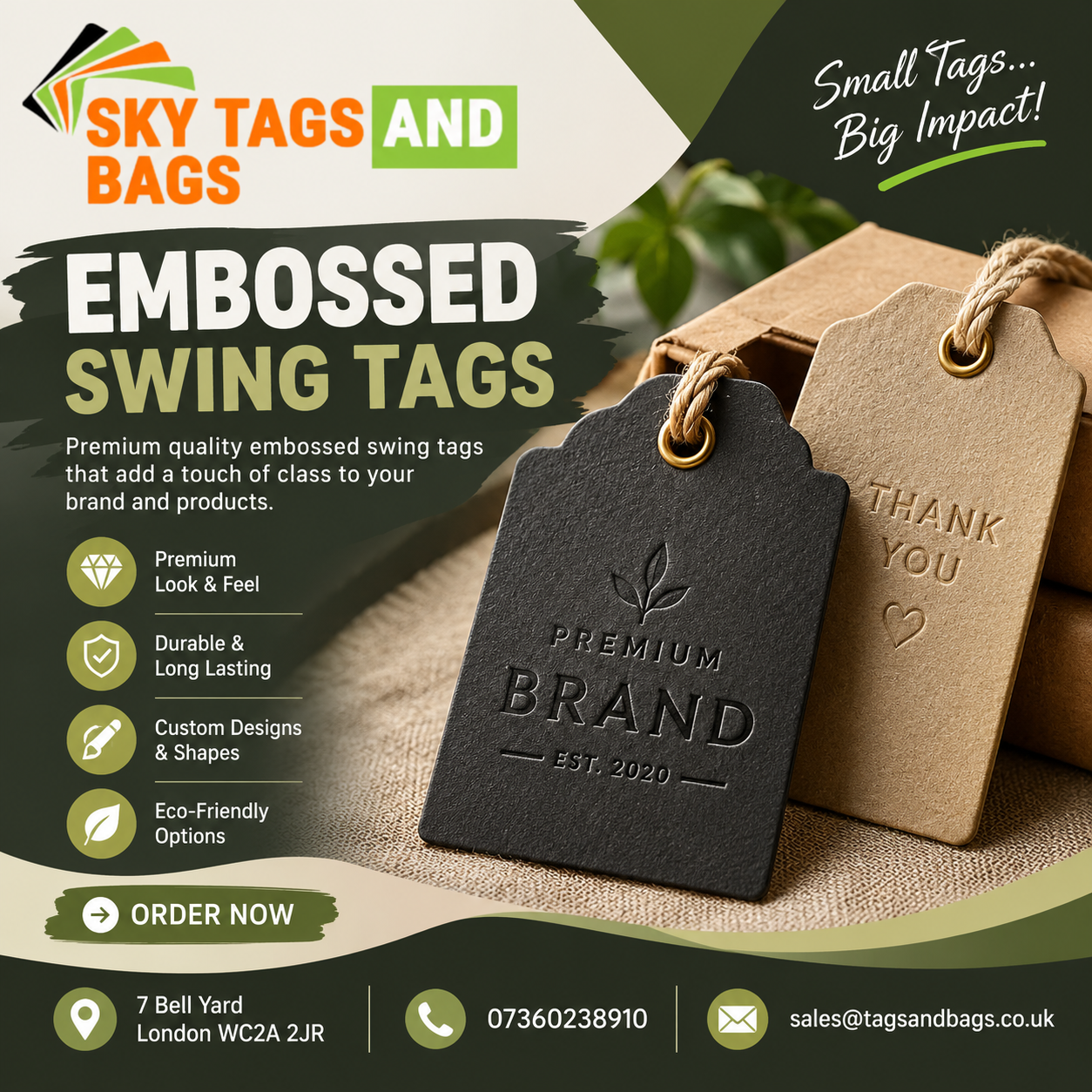
In competitive retail environments, packaging often plays an important role in how customers perceive a product. While the main packaging protects and presents the item, smaller details can help communicate brand identity, product information, and attention to quality. One such detail is the swing tag.
For fashion, gifting, handmade products, accessories, and specialist retail goods, embossed swing tags can provide both practical information and a distinctive tactile element. By creating a raised design or lettering on the surface of a card tag, embossing gives packaging an additional layer of texture that can make a product presentation feel more considered.
What Are Embossed Swing Tags?
An embossed swing tag is a printed or unprinted card tag featuring raised text, patterns, logos, or other design elements. The embossing process presses the chosen design into the card using a specialised die, creating a three-dimensional effect that can be felt as well as seen.
Swing tags are commonly attached to products using string, ribbon, elastic, or other suitable fasteners. They can display information such as:
- Brand or business name
- Product descriptions
- Sizes or product variations
- Care instructions
- Pricing information
- Website or social media details
- Short messages or branding statements
The combination of functional information and tactile design makes embossed tags useful for businesses that want packaging to communicate quality without relying solely on colour or graphics.
Why Texture Matters in Product Presentation
Packaging design increasingly considers more than visual appearance. Texture can influence how customers interact with a product because physical surfaces provide another sensory element.
Embossing can be particularly effective when used selectively. A raised logo, brand name, border, or small decorative detail can create contrast against a smooth card surface. It can also help important elements stand out without requiring excessive use of colours or complex artwork.
For businesses developing packaging, the following factors are worth considering:
- Card thickness: The chosen material needs to be suitable for the embossing process and the intended use.
- Design simplicity: Fine details may not reproduce as effectively as clear shapes and lettering.
- Placement: Embossed elements should support the overall layout rather than compete with essential product information.
- Brand consistency: Typography, logos, and colours should complement other packaging materials.
- Durability: Tags should remain readable and presentable during handling, storage, and transportation.
These considerations are particularly relevant when developing embossed swing tags UK businesses can use across different product ranges and retail environments.

Common Applications for Embossed Tags
Embossed swing tags can be adapted to a wide variety of industries. Fashion retailers may use them on clothing, accessories, footwear, and textile products. Handmade and craft businesses can use textured tags to complement the personal nature of their products.
Other applications include:
Fashion and Clothing
Clothing labels and swing tags often need to combine branding with practical information such as size, material, and care guidance. An embossed logo can provide a subtle visual and tactile distinction.
Gift and Lifestyle Products
Gift products frequently depend on presentation. A textured tag can complement gift boxes, tissue paper, ribbons, and other packaging components while providing space for a short message or product information.
Handmade and Artisan Goods
For handmade products, packaging can reinforce the idea of craftsmanship. A carefully designed embossed tag can work alongside natural card, recycled materials, or minimalist printing.
Retail Accessories
Jewellery, bags, scarves, wallets, and other accessories can benefit from compact tags that provide branding without taking attention away from the product itself.
Common Challenges and How to Avoid Them
One common mistake is treating embossing as purely decorative. A successful tag should still communicate information clearly. If the raised design is too large or complicated, it can interfere with typography and reduce readability.

Another challenge is selecting unsuitable artwork. Extremely thin lines, very small text, or complicated patterns may not produce the desired embossed effect.
Before production, businesses should therefore check:
- Whether the artwork is suitable for embossing
- Whether the card stock provides enough structure
- Whether text remains easy to read
- Whether the tag size suits the product
- Whether the fastening method is appropriate
- Whether the finished tag complements the wider packaging design
It is also useful to request a proof or sample where possible. A physical sample can reveal differences in texture, scale, contrast, and readability that may not be obvious on a computer screen.
Choosing a Practical Design for UK Retail
Businesses considering embossed swing tags should think about the entire customer journey rather than the tag in isolation. The tag may be handled in a shop, attached to a garment, included inside a parcel, or removed before the product is used.
For UK retailers and online sellers, consistency is especially useful when packaging is distributed across multiple product lines. A repeatable tag format can help maintain a recognisable visual identity while allowing product-specific information to change.
Material selection is another important consideration. Smooth coated card can create a different appearance from textured or uncoated stock, while recycled or kraft-style materials may suit brands aiming for a more natural packaging aesthetic.
Tags and Bags, for example, provides embossed swing tag options that can be considered as part of a wider packaging specification rather than as an isolated branding element.

Final Considerations
Packaging does not always need elaborate graphics to make an impression. Small physical details, such as raised lettering or a textured logo, can contribute to the way a product is presented and handled.
The most effective embossed swing tags UK retailers use are generally those that balance appearance with practical requirements. Appropriate card stock, clear artwork, sensible tag dimensions, and useful product information all contribute to a successful result.
For businesses reviewing their packaging, embossing is therefore worth considering as one part of a broader design strategy. When used thoughtfully, it can add texture, reinforce brand identity, and give customers a more engaging physical interaction with the product.
Категории
Больше
The Silica Flour Market size is expected to reach US$ 2.88 billion by 2033 from US$ 2.11 billion in 2025. The market is estimated to record a CAGR of 3.97% from 2026 to 2033. The retrieved public source material for this batch did not expose all three headline values required for a verified numerical opening, so no market-size figure or CAGR is inferred. Market growth is best understood as the...

The global Glass Container Market is projected to grow from USD 67.4 billion in 2026 to USD 94.2 billion by 2036, advancing at a 3.4% CAGR during the forecast period, according to Future Market Insights (FMI). The market was valued at USD 65.2 billion in 2025, with beverage, food, pharmaceutical, and beauty packaging continuing to support demand for glass bottles, jars, vials, and specialty...

Asia-Pacific has become a major center of geomembrane demand due to rapid urbanization, infrastructure investment, industrial development, and large-scale environmental projects. The region's extensive waste-management, water-management, mining, and agricultural activities are supporting substantial consumption. The Geomembranes Market reports that Asia-Pacific captured 48.2% of global market...
According to the latest report published by Data Bridge Market Research, the Himalayan Pink Salt Market CAGR Value Data Bridge Market Research analyses that the global himalayan pink salt market to account USD 4.75 billion by 2029 growing at a CAGR of 4.5%% in the forecast period of 2022-2029. For structuring the finest market research report like this Himalayan Pink...
According to the latest report published by Data Bridge Market Research, the Next-Generation Memory Market The global next-generation memory market size was valued at USD 11.74 billion in 2025 and is expected to reach USD 94.65 billion by 2033, at a CAGR of 29.8% during the forecast period. Quality and transparency has been strictly maintained while carrying out research studies to...