6-APB Powder Explained: Chemistry, Composition, and Research Context
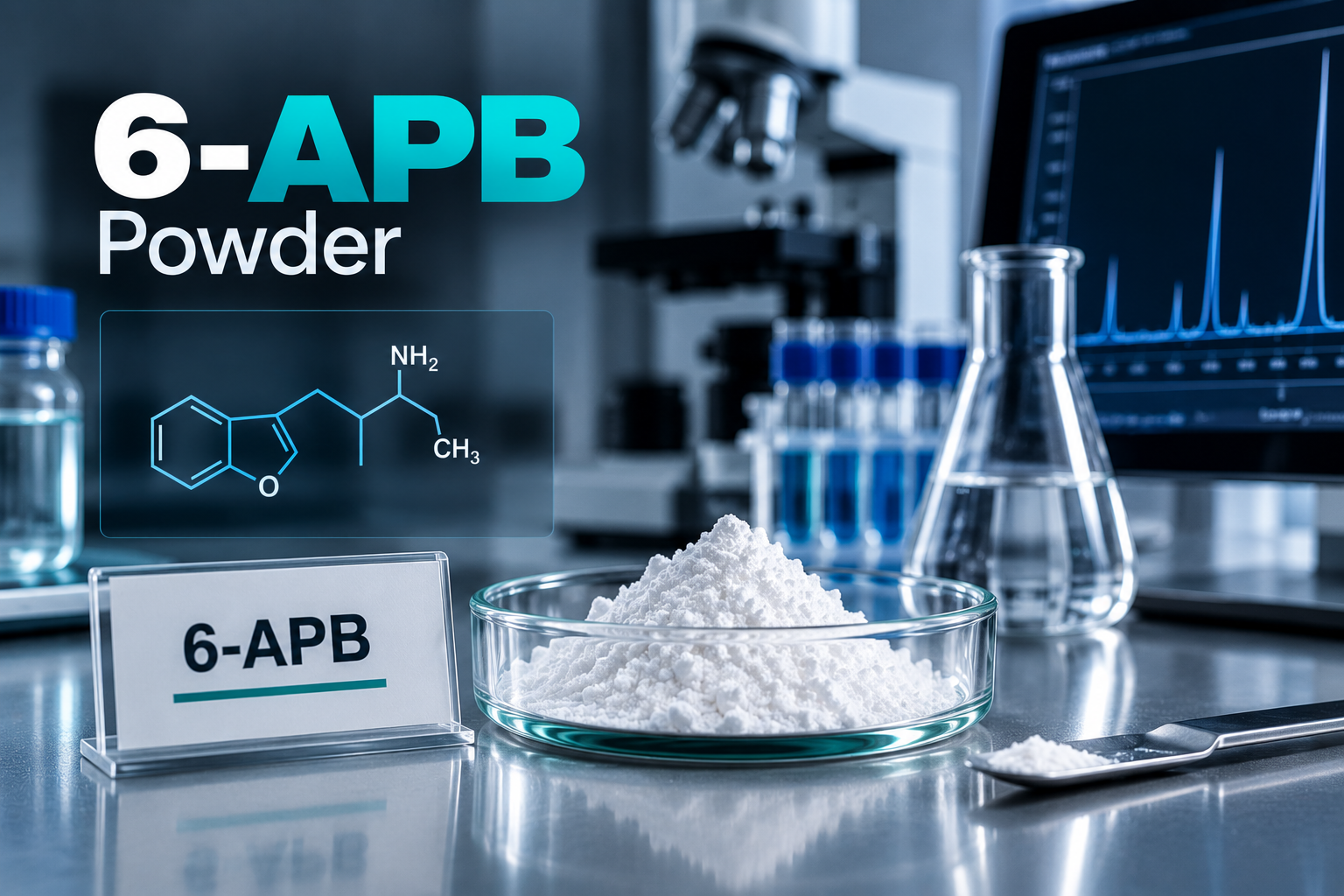
6-APB, short for 6-(2-aminopropyl)benzofuran, is a synthetic benzofuran compound that has been studied within the broader field of new psychoactive substances (NPS). When described as a powder, the term refers primarily to the physical presentation of the material rather than a different chemical form of 6-APB.
Understanding the Chemistry
6-APB contains a benzofuran ring system connected to an aminopropyl side chain. It is structurally related to other aminopropylbenzofurans, including 5-APB. Small changes in the position of the side chain on the benzofuran ring can create different positional isomers with distinct analytical characteristics.
Research has demonstrated that 5-APB and 6-APB can be differentiated using chromatographic and spectrometric techniques.
What Does Powder Composition Mean?
The appearance of a powder cannot establish its chemical identity or purity. Color, texture, and particle characteristics are physical observations and do not provide definitive information about molecular composition.
Laboratory characterization can provide a much clearer picture. Analytical techniques such as gas chromatography–mass spectrometry (GC-MS), liquid chromatography–mass spectrometry (LC-MS), and high-resolution mass spectrometry have been used to identify 6-APB and distinguish it from related benzofuran compounds.
Research and Analytical Context
Scientists have investigated 6-APB in forensic and toxicological research, including methods for detecting the compound in biological samples. Validated HPLC-MS/MS methods have also been developed for simultaneously identifying 5-APB and 6-APB in blood and other biological matrices.
Analytical research is particularly important because products represented as benzofuran compounds may contain related substances or positional isomers. Reliable laboratory methods can therefore help establish chemical identity rather than relying on labeling or appearance alone.
Why Characterization Matters
6-APB remains a compound of research and forensic interest, while available information about its toxicology and long-term effects remains limited. Scientific literature emphasizes the importance of validated analytical methods when investigating NPS because mislabeling and unexpected compositions can complicate interpretation.
Overall, understanding 6-APB powder requires looking beyond its physical appearance. Chemical identity, composition, analytical methodology, and appropriate laboratory documentation provide a more meaningful framework for characterizing the material.
References
Categories
Read More
Steal a Brainrot thrives on quick reactions, odd personalities, and the small decisions that shape a player's inventory over time. Newcomers often arrive looking for a single standout piece, yet the most satisfying sessions usually begin with observation and a modest plan.Before joining a server, it helps to review Steal a Brainrot Brainrots as part of a wider collecting routine, because...

The Edible Oil Alternatives Market size was valued at US$ 80.25 billion in 2025 and is projected to reach US$ 141.6 billion by 2033, registering a CAGR of 7.36% during 2026–2033. The retrieved public source material for this batch did not expose all three headline values required for a verified numerical opening, so no market-size figure or CAGR is inferred. Market growth is best...
Power MOSFET Market: Electrification, Energy Efficiency and Advanced Power Electronics Drive Market Growth The global Power MOSFET Market is expanding as demand for efficient power-management components increases across automotive, consumer electronics, industrial equipment, energy systems, telecommunications, and data-center infrastructure. According to Maximize Market Research, the...
Propyl Gallate Market Market Overview The global Propyl Gallate Market is gaining steady momentum due to the increasing use of propyl gallate as an antioxidant across food and beverages, pharmaceuticals, cosmetics, animal feed, adhesives, chemicals, and paper applications. Propyl gallate is an odorless, creamy white crystalline powder with a slightly bitter taste and is naturally found in...
The Collation Shrink Film Market is projected to increase from USD 4.4 billion in 2026 to USD 6.9 billion by 2036, expanding at a 4.6% CAGR, according to Future Market Insights. Demand is being shaped by beverage multipack packaging, automated wrapping operations, and e-commerce fulfillment, while films measuring 50 to 100 micron account for 38% of the market in 2026. The question of...